
You may also like…
-

Update Service Program
Price range: $13.99 through $90.00 Select options This product has multiple variants. The options may be chosen on the product page -
Colorado All-On-One™ Labor Law Poster
$34.95 Select options This product has multiple variants. The options may be chosen on the product page -
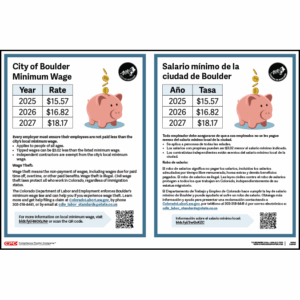
Boulder, CO Minimum Wage Poster
$16.95 Add to cart
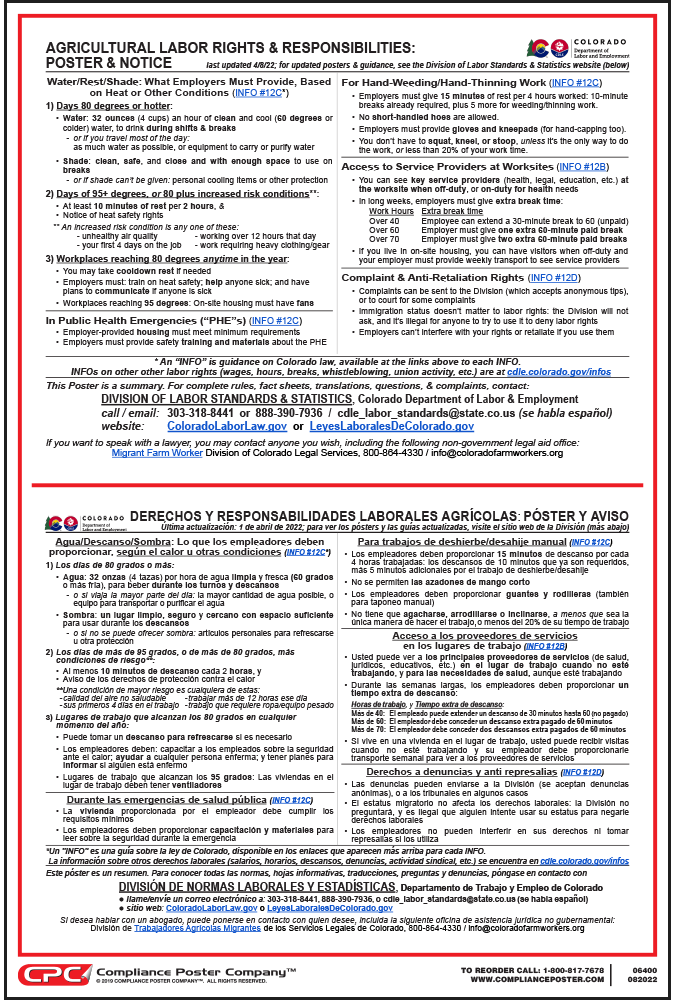
Who must post the Colorado Agricultural Labor Rights & Responsibilities Poster?
Pursuant to Colorado Revised Statutes § 8-13.5-202, all Colorado agricultural employers are required to post the Colorado Agricultural Labor Rights & Responsibilities Poster. Under the Agricultural Labor Rights & Responsibilities Act (ALRRA), an agricultural employer is defined as a person who:
- regularly engages the services of one or more employees or contracts with any person who recruits, solicits, hires, employs, furnishes, or transports employees; and
- is engaged in farming including operations incident to farming operations, as defined in Fair Labor Standards Act (FLSA) 29 U.S.C. § 203(f), or is engaged in agricultural labor per IRS Code 26 U.S.C. § 3121 (g).
Where are agricultural employers required to post the Colorado Agricultural Labor Rights & Responsibilities Poster?
The Agricultural Labor Rights & Responsibilities Poster must be posted:
- in a conspicuous location on the agricultural employer’s premises, including in the agricultural worker’s employer-provided housing; and
- in all places where notices to employees, including agricultural workers, are customarily posted; and
- electronically, including by e-mail and on an intranet or internet site, if the agricultural employer customarily communicates with agricultural employees by these means.
Colorado agricultural employers must also post the mandatory postings included on Colorado All-On-One™ Posters in English and Spanish, in places where agricultural workers can easily read them during the workday. (7 CCR 1103-11, Rule 4).
How are workers protected under the ALRRA?
The ALRRA Poster describes the protections agricultural employers must provide to workers in regard to:
- Water, rest and shade protection based on heat and other conditions
- Housing, safety training and information in Public Health Emergencies
- Hand-weeding/hand-thinning work protections
- Access to key service providers
- Worker complaint and anti-retaliation rights
- Who to contact for information or to file a complaint and how to get help through legal aid